
Property Developers Accepting Crypto in Dubai 2026
Table of Contents
Introduction: Dubai’s Crypto-Friendly Real Estate Revolution
Property developers accepting cryptocurrency in Dubai has multiplied in the last 2 years. This is because Dubai has positioned itself as the global capital of crypto real estate. While other cities debate cryptocurrency regulations, Dubai is actively building infrastructure to welcome digital asset holders into its property market.
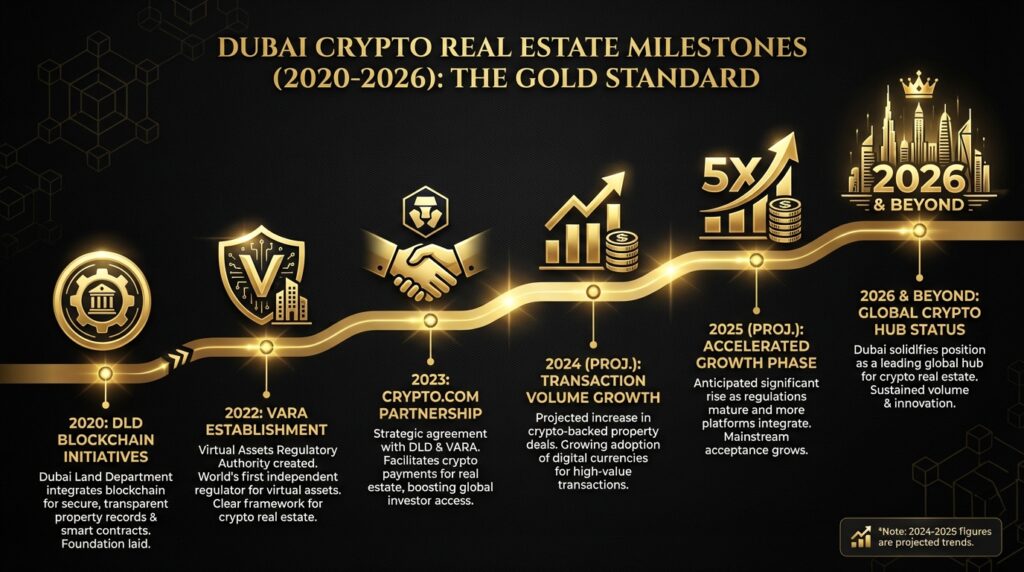
In 2025 alone, cryptocurrency-backed property transactions in Dubai exceeded AED 15 billion, and that number is accelerating in 2026. The Dubai Land Department’s partnership with Crypto.com, VARA’s clear regulatory framework, and major developers embracing digital payments have created the world’s most crypto-friendly property market.
But here’s what most buyers don’t know: not all developers accept crypto directly. Some work through OTC partners, others have specific cryptocurrency preferences, and payment processes vary significantly.
This guide cuts through the confusion. Below, you’ll find the complete, updated list of Dubai developers accepting cryptocurrency, along with exactly which cryptos they accept, what projects are available, and how the payment process actually works.
Complete List of Developers Accepting Cryptocurrency in Dubai (2026)
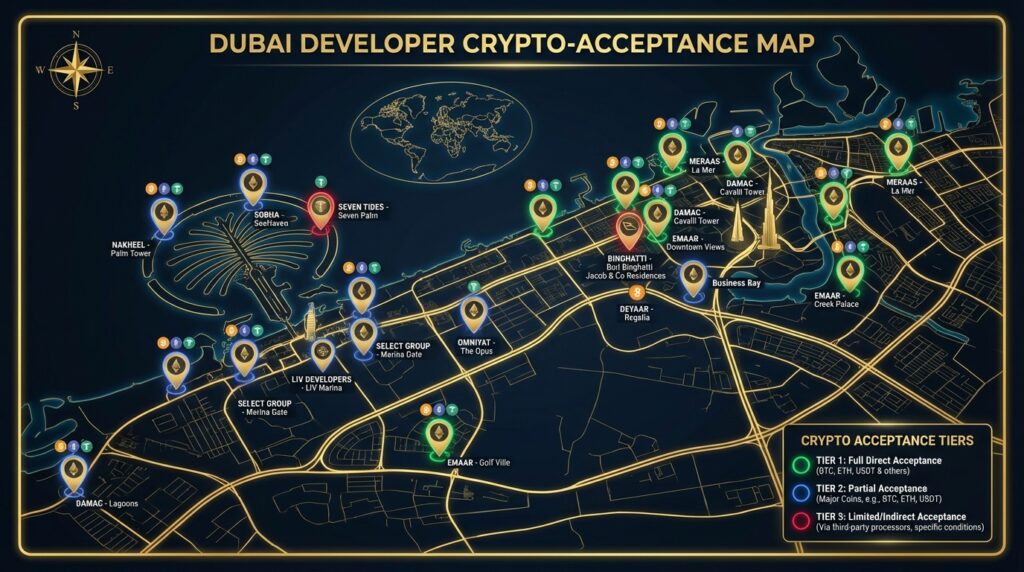
The following developers have confirmed cryptocurrency payment options for property purchases. This list is updated regularly as more developers join the crypto-friendly ecosystem.
Tier 1: Major Developers with Direct Crypto Acceptance
| Developer | Accepted Cryptos | Property Types | Notable Projects | Payment Method |
| DAMAC Properties | BTC, ETH | Apartments, Villas, Branded Residences | DAMAC Hills, Cavalli Tower, Safa One | Direct via licensed OTC partner |
| Emaar Properties | BTC, ETH, USDT | Apartments, Villas, Penthouses | Downtown Dubai, Dubai Hills, Emaar Beachfront | Via approved payment processor |
| Nakheel | BTC, ETH, USDT, USDC | Villas, Apartments, Plots | Palm Jumeirah, Palm Jebel Ali, Nakheel Communities | Partnership with Hayvn |
| Binghatti | BTC, ETH | Apartments, Branded Residences | Binghatti Ghost, Mercedes-Benz Places | Direct acceptance |
| Sobha Realty | BTC, ETH, USDT | Villas, Apartments | Sobha Hartland, Sobha One, Sobha Seahaven | Via approved exchange |
Tier 2: Luxury & Boutique Developers
| Developer | Accepted Cryptos | Property Types | Notable Projects | Payment Method |
| Omniyat | BTC, ETH | Ultra-luxury apartments, Penthouses | One at Palm Jumeirah, The Opus, Dorchester Collection | Via approved payment processor |
| Ellington Properties | BTC, ETH | Boutique apartments, Townhouses | Ellington Beach House, Wilton Terraces | Through preferred crypto brokerage |
| Select Group | BTC, ETH, USDT | Waterfront apartments | Six Senses Residences, Peninsula | Direct via OTC partner |
| Azizi Developments | BTC, ETH | Apartments | Azizi Venice, Azizi Riviera | Via licensed exchange |
| Samana Developers | BTC, ETH, USDT | Apartments | Samana Golf Avenue, Samana Waves | Direct acceptance |
Tier 3: Emerging & Specialized Developers
| Developer | Accepted Cryptos | Property Types | Notable Projects | Payment Method |
| Reportage Properties | BTC, ETH | Affordable luxury | Reportage Village, Reem Hills | Via OTC partner |
| Imtiaz Developments | BTC, ETH | Mid-market apartments | Solitaire Cascades | Via exchange partner |
| Pantheon Development | BTC, ETH, USDT | Luxury apartments | Pantheon Elysee | Direct acceptance |
| Palma Holding | BTC, ETH | Luxury villas | Palma Residences | Via approved processor |
| The Devmark | BTC, ETH | Boutique projects | Devmark properties | Direct acceptance |
| BLOOM Holding | BTC, ETH | Abu Dhabi & Dubai | Bloom Living, Bloom Towers | Via licensed OTC |
| Arada | BTC, ETH | Community developments | Aljada, Masaar | Via designated crypto partners |
Which Cryptocurrencies Are Accepted?
Not all cryptocurrencies are treated equally in Dubai real estate. Here’s the breakdown of what’s actually accepted and why:
Most Widely Accepted
| Cryptocurrency | Acceptance Rate | Why It’s Popular |
| Bitcoin (BTC) | 100% of crypto-friendly developers | Market leader, highest liquidity, most recognized |
| Ethereum (ETH) | 95% of crypto-friendly developers | Second largest, smart contract capabilities |
| Tether (USDT) | 70% of crypto-friendly developers | Stablecoin, eliminates price volatility during transaction |
| USD Coin (USDC) | 50% of crypto-friendly developers | Regulated stablecoin, institutional preference |
Occasionally Accepted
| Cryptocurrency | Acceptance Rate | Notes |
| BNB | 20% | Binance ecosystem, growing acceptance |
| SOL | 10% | Newer, limited but expanding |
| XRP | 15% | Especially for tokenization projects |
Pro Tip: Stablecoins for Smoother Transactions
While Bitcoin and Ethereum are widely accepted, their price volatility can complicate transactions. A 5% price swing during a 48-hour settlement period could mean a significant difference in property value.
Our recommendation: Convert volatile crypto to USDT or USDC before initiating the property transaction. This locks in your purchasing power and simplifies the conversion to AED for final registration.
How the Payment Process Works
Understanding the actual mechanics of paying with cryptocurrency eliminates surprises and ensures smooth transactions.
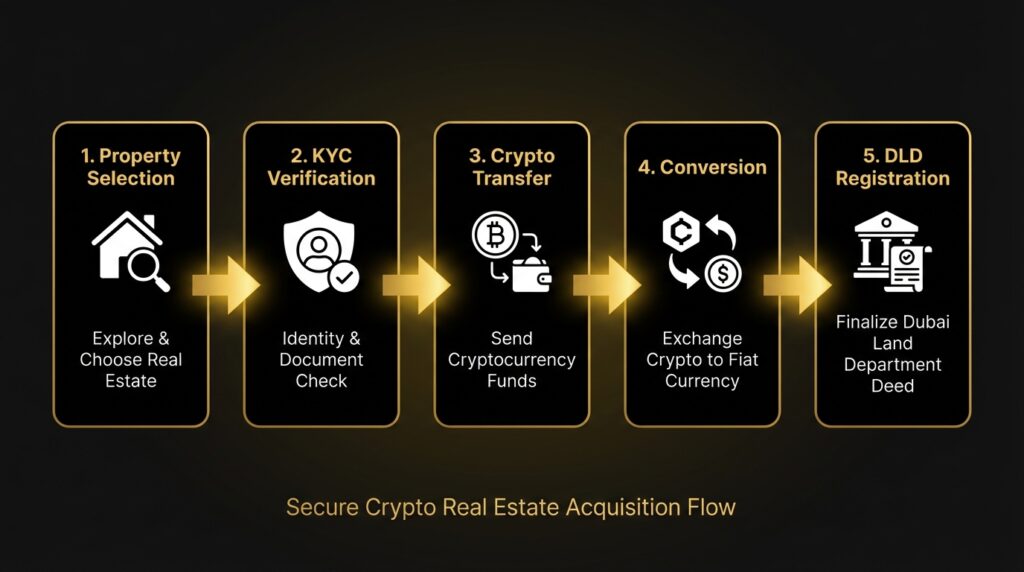
Step-by-Step Process
Step 1: Property Selection & Reservation
- Choose your property from a crypto-accepting developer
- Sign a reservation agreement (typically requires 5-10% deposit)
- Agree on the cryptocurrency type and conversion method
Step 2: KYC & AML Compliance
- Complete Know Your Customer verification
- Provide proof of crypto ownership and source of funds
- Both VARA and DLD require compliance checks
Step 3: Crypto Transfer
- Transfer cryptocurrency to the developer’s designated wallet OR
- Transfer to a licensed OTC partner for conversion
- Receive confirmation of receipt
Step 4: Conversion to AED
- Cryptocurrency is converted to UAE Dirhams
- Conversion rate locked at time of transfer (or per agreement)
- Licensed exchanges handle the conversion
Step 5: Final Registration
- Payment completed in AED to Dubai Land Department
- Title deed issued in your name
- Property officially registered
Important: Final Registration is Always in AED
Regardless of how you pay, the Dubai Land Department registers all transactions in UAE Dirhams. This means your crypto must be converted at some point in the process, the question is who handles that conversion and when.
Three conversion scenarios:
| Scenario | Who Converts | When | Best For |
| Developer handles | Developer’s OTC partner | At transfer | Buyers wanting simplicity |
| Buyer converts first | Buyer’s chosen exchange | Before payment | Buyers wanting rate control |
| Brokerage coordinates | Licensed OTC network | During transaction | Buyers wanting expert guidance |
Off-Plan vs Ready Properties: What’s Available for Crypto?
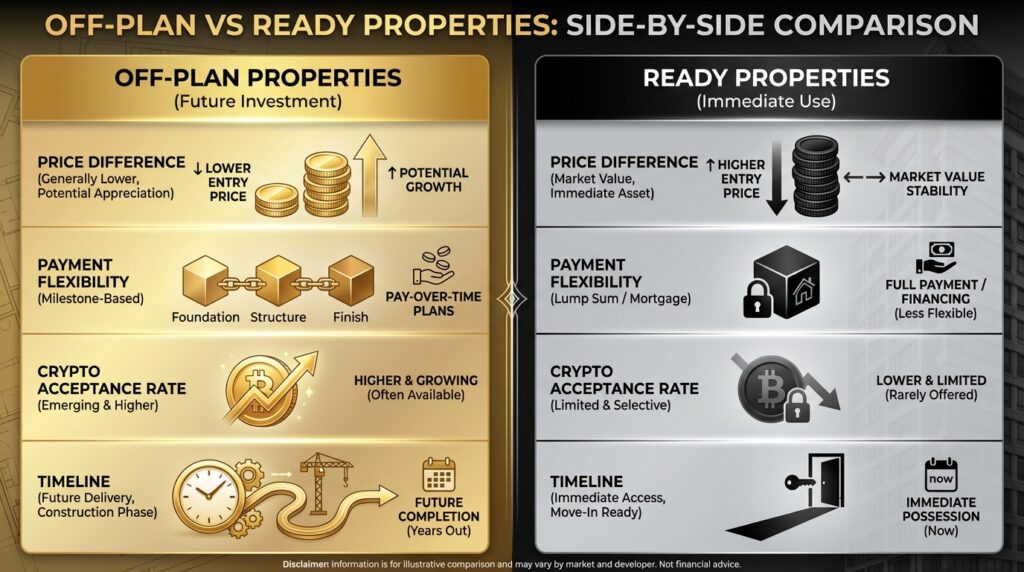
Cryptocurrency acceptance varies between off-plan (under construction) and ready (completed) properties.
Off-Plan Properties
Crypto Acceptance: High (most developers accept crypto for off-plan)
Advantages:
- Lower entry prices (typically 10-20% below ready property prices)
- Flexible payment plans (often 60/40 or 70/30 splits)
- Multiple payment milestones allow crypto payments at each stage
- Higher potential for capital appreciation
Payment Structure Example:
| Milestone | Percentage | Crypto Accepted? |
| Booking | 10% | ✅ Yes |
| Within 30 days | 10% | ✅ Yes |
| Construction 50% | 20% | ✅ Yes |
| Construction 100% | 20% | ✅ Yes |
| Handover | 40% | ✅ Yes |
Ready Properties
Crypto Acceptance: Medium (depends on seller willingness)
Considerations:
- Secondary market (resale) requires seller agreement
- Developer ready stock usually accepts crypto
- Faster transaction timeline (weeks vs months/years)
- Immediate rental income potential
Our Recommendation
For crypto buyers, off-plan properties from major developers offer the smoothest crypto payment experience. Developers like DAMAC, Emaar, and Nakheel have established crypto payment processes, while secondary market transactions require more coordination.
Legal Framework: VARA and DLD Regulations
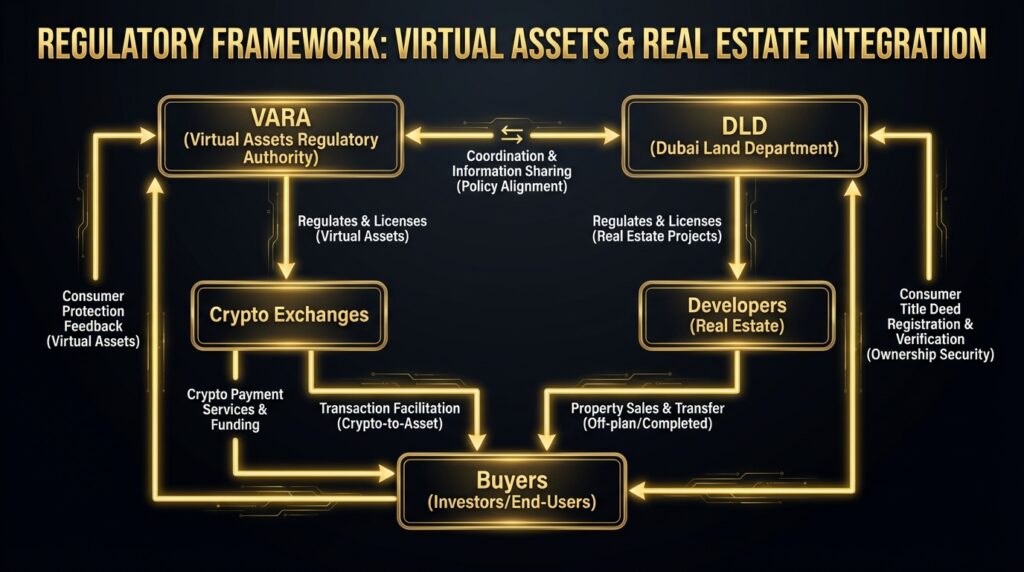
Dubai’s cryptocurrency real estate transactions operate within a clear regulatory framework, one of the reasons the emirate leads globally in crypto adoption.
Virtual Assets Regulatory Authority (VARA)
Established in 2022, VARA governs all virtual asset activities in Dubai, including:
- Licensing of crypto exchanges and OTC desks
- Compliance requirements for crypto transactions
- Consumer protection standards
- Anti-money laundering (AML) enforcement
What this means for buyers: Only use VARA-licensed exchanges and OTC partners. Transactions through unlicensed entities may face legal complications.
Dubai Land Department (DLD)
The DLD oversees all property transactions and has embraced blockchain technology:
- Blockchain-based registration: Property records stored on blockchain for transparency
- Crypto.com partnership (2025): Infrastructure for digital asset property transactions
- Tokenization initiatives: Pilot programs for fractional property ownership
Key DLD requirements:
- All final registrations in AED
- 4% transfer fee applies regardless of payment method
- Title deed issued in buyer’s name
- Standard property ownership rights apply
Compliance Checklist for Crypto Buyers
| Requirement | Why It Matters | How to Comply |
| Source of funds documentation | AML compliance | Provide wallet history, exchange records |
| KYC verification | Identity confirmation | Passport, proof of address |
| VARA-licensed conversion | Legal compliance | Use only licensed OTC partners |
| DLD registration | Official ownership | Complete through authorized channels |
Tips for Buying from Developers with Crypto
After facilitating numerous crypto property transactions, here are the insider tips that make the difference:
1. Lock Your Rate Early
Crypto prices fluctuate. Negotiate a rate-lock agreement that specifies:
- The exact conversion rate
- The time window for transfer
- What happens if you miss the window
2. Use Stablecoins for Large Transactions
For purchases over $1 million, consider converting to USDT or USDC before initiating the transaction. This eliminates volatility risk during the settlement period.
3. Document Everything
Maintain records of:
- Wallet addresses used
- Transaction hashes
- Exchange correspondence
- Conversion confirmations
This documentation may be required for:
- Golden Visa applications
- Future resale
- Tax reporting in your home country
4. Understand the Fee Structure
Crypto transactions involve multiple fees:
| Fee Type | Typical Range | Who Pays |
| Network fees (gas) | Variable | Buyer |
| OTC conversion spread | 0.5-2% | Buyer |
| Exchange fees | 0.1-0.5% | Buyer |
| DLD transfer fee | 4% | Buyer |
| Agent commission | 2% (off-plan) | Developer pays |
5. Work with Crypto-Experienced Professionals
Traditional real estate agents often lack crypto transaction experience. Key questions to ask:
- How many crypto transactions have you completed?
- Which OTC partners do you work with?
- Can you explain the conversion process in detail?
Why Work with a Crypto-Native Brokerage
The difference between a traditional brokerage “accepting crypto” and a crypto-native brokerage is significant:
| Traditional Brokerage | Crypto-Native Brokerage |
| Crypto is an afterthought | Built for crypto buyers from day one |
| Limited OTC relationships | Extensive OTC partner network (50+) |
| Learning the process | Mastered the process |
| Generic advice | Crypto-specific guidance |
| Post-sale: “Good luck” | Integrated property management |
The Luxury Crypto Properties Difference
We don’t just “accept” cryptocurrency, we specialize in it. Our network of 50+ licensed OTC partners across Africa, Europe, Asia, and the Middle East ensures:
- Best conversion rates: through competitive partner quotes
- Fastest processing: via established relationships
- Complete compliance: with VARA and DLD requirements
- End-to-end service: from property search to property management
Whether you’re buying a Palm Jumeirah penthouse with Bitcoin or a Dubai Hills villa with Ethereum, we speak your language and understand your needs.
Frequently Asked Questions
Is it legal to buy property in Dubai with cryptocurrency?
Yes, buying property with cryptocurrency in Dubai is fully legal. Transactions must comply with VARA (Virtual Assets Regulatory Authority) regulations and DLD (Dubai Land Department) requirements. The final registration is always completed in AED, so cryptocurrency is converted through licensed channels during the process.
Which Dubai developers accept Bitcoin?
Major developers accepting Bitcoin include DAMAC Properties, Emaar Properties, Nakheel, Binghatti, Sobha Realty, Omniyat, Ellington Properties, Select Group, Azizi Developments, and Samana Developers. Most Tier 1 and Tier 2 developers in Dubai now have cryptocurrency payment options.
What cryptocurrencies can I use to buy property in Dubai?
Bitcoin (BTC) and Ethereum (ETH) are accepted by virtually all crypto-friendly developers. Tether (USDT) and USD Coin (USDC) are accepted by approximately 70% and 50% of developers respectively. Some developers also accept BNB, SOL, and XRP, though acceptance is more limited.
Do I need to convert crypto to AED before buying property?
The final property registration with DLD must be in AED, so conversion happens at some point. However, you can either convert yourself before payment, let the developer’s OTC partner handle conversion, or work with a brokerage that coordinates the conversion. The timing and method affect the rate you receive.
Are there additional fees for paying with cryptocurrency?
Yes, crypto transactions involve network fees (gas), OTC conversion spreads (typically 0.5-2%), and exchange fees (0.1-0.5%). These are in addition to standard property purchase costs like the 4% DLD transfer fee. Working with experienced crypto brokerages can help minimize conversion costs through competitive OTC partner networks.
Can I buy off-plan property with cryptocurrency?
Yes, off-plan properties are actually the easiest to purchase with cryptocurrency. Most major developers have established crypto payment processes for off-plan projects, and the milestone payment structure allows you to pay in crypto at each stage. Off-plan also typically offers better pricing and payment flexibility.
How long does a crypto property transaction take?
A crypto property transaction typically takes 2-4 weeks from reservation to completion. The crypto transfer and conversion can be completed in 24-48 hours, while KYC verification, documentation, and DLD registration take the remaining time. This is often faster than traditional bank transfers for international buyers.
Do I qualify for Golden Visa if I buy property with crypto?
Yes, the payment method does not affect Golden Visa eligibility. If you purchase property worth AED 2 million or more, you qualify for the 10-year Golden Visa regardless of whether you paid with cryptocurrency, bank transfer, or cash. The property value and ownership structure determine visa eligibility.
What documentation do I need for a crypto property purchase?
You’ll need: valid passport, proof of address, source of funds documentation (wallet history, exchange records), KYC verification documents, and proof of crypto ownership. Additional documentation may be required depending on the developer and transaction size. Proper documentation also supports future Golden Visa applications and resale.
Can I buy secondary market (resale) property with crypto?
Yes, but it depends on seller willingness. Unlike off-plan purchases from developers with established crypto processes, secondary market transactions require the seller to agree to crypto payment. Working with a crypto-specialized brokerage increases your chances of finding crypto-friendly sellers and coordinating the transaction smoothly.
Ready to Buy Dubai Property with Cryptocurrency?
Luxury Crypto Properties is Dubai’s dedicated real estate brokerage for crypto natives. With our network of 50+ licensed OTC partners and deep expertise in cryptocurrency transactions, we make buying luxury Dubai property with Bitcoin, Ethereum, or stablecoins seamless.